
Model 01 · Single node
Arkiv node on one Raspberry Pi 5
Run an Arkiv node with a local RPC endpoint. A compact starting point for your application, on infrastructure you own.

Arkiv RPC · Proxy & Load Balancer
Web3 Pi turns many Raspberry Pi 5 nodes into one high‑throughput Arkiv RPC endpoint — on your own infrastructure, with no third‑party rate limits.
01 Live load balancer
Every node in this view is a real Arkiv node in the running proof of concept. The proxy checks each one every 2 seconds and sends requests only to the nodes that pass.

Tip: click a node to take it offline in the simulation — the proxy routes around it.
02 The problem
Every Arkiv app reaches the chain through RPC. Shared public endpoints have to ration their capacity — sooner or later, your app hits a rate limit.
Sign up, get a key, keep an eye on your quota.
Throttled just when your app starts to grow.
Everyone’s traffic hits the same backends.
No view of which node answers — or how healthy it is.
# anonymous access · stage 2 · 10 req/s
→ arkiv_query       200 OK
→ arkiv_getEntity   200 OK
→ arkiv_query       429 Too Many Requests
  ratelimit:   limit=10000, remaining=0, reset=3573
  retry-after: 3573
03 Two ways to run it
Two ways to run Arkiv RPC on your own hardware — both built on Web3 Pi.
Model 01 · Single node
Run an Arkiv node with a local RPC endpoint. A compact starting point for your application, on infrastructure you own.
Model 02 · Fleet
Many small devices behind one endpoint. The Web3 Pi proxy load‑balances every request across healthy nodes for high throughput.
04 How it works
The Web3 Pi Arkiv RPC Proxy load‑balances requests across the nodes. Monitoring runs on its own, separate path.
HTTP JSON‑RPC clients
Load balancer · health-aware
Eligibility · checked every 2 s
Load balancing
Selection considers in‑flight load, node weight and observed latency. Pool and rules reload live.
Raspberry Pi 5 · NVMe · execution + consensus clients
Add a node — no restart
Apps connect to a single URL. The fleet stays behind it.
Each request goes to the least busy healthy node.
Designed to scale by adding nodes — no restart.
Your capacity. No third‑party rate limits.
The proxy is conservative about what it repeats and where it sends traffic.
eth_getLogs instead.
05 Hardware platform
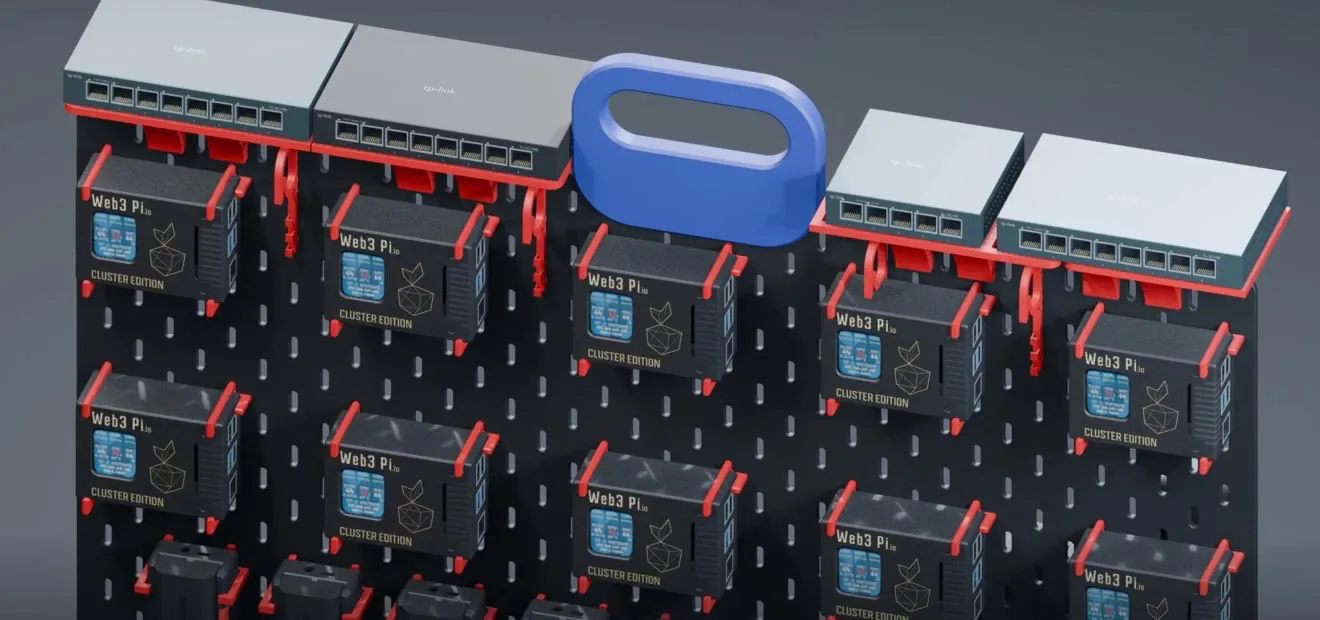
Web3 Pi Cluster Edition puts ten Raspberry Pi 5 nodes, NVMe storage, battery backup and a dedicated network on a single board — one you can carry by the handle.
Cluster Edition hardware platform. RPC tests: 8 Raspberry Pi 5 + 3 x86 nodes.
Explore the Cluster Edition

Raspberry Pi 5 and x86 nodes, read from the monitoring path.
06 Control center
One Web3 Pi dashboard for the whole fleet — live, with real data from the running proof of concept.
Requests per second, latency and errors as they happen.
Only nodes that are ready receive traffic.
Head block and lag, checked against the network.
CPU, temperatures, memory, NVMe, network, execution and consensus clients.
The public dashboard is read‑only. Operators manage nodes and routing rules in a separate, authenticated panel.
Open the public dashboard07 Status
The proof of concept is live on Arkiv Tiramisu testnet, serving real HTTPS traffic through one public endpoint.
live on Arkiv Tiramisu testnet
10× Raspberry Pi 5 + 3× x86
28,800 of 28,800 requests
40 / 80 / 120 RPS · 120 s per stage
p95 217–221 ms
Add, pause or remove a node. Changes apply live.
Demo run, 16 October 2026: historical Arkiv read workload (replay) sent through the public HTTPS endpoint from the local network. A bounded demonstration, not a maximum‑capacity test.
Indicative performance
In our tests, the mixed Web3 Pi fleet served more Arkiv RPC traffic than the official endpoint used with an access key. No third‑party rate limits.
Internal tests on Arkiv Tiramisu, 16 October 2026. 8 Raspberry Pi 5 + 3 x86 versus the official endpoint with an access key, using the same historical read workload. Local‑origin HTTPS for the proxy, WAN for the reference. Indicative results under tested conditions, not an SLA.
08 Why it matters
For builders
Keep control of access and infrastructure capacity as your application grows.
For node runners
Operate Arkiv nodes with routing and telemetry in one Web3 Pi stack.
For the Arkiv ecosystem
A practical reference for community‑operated infrastructure alongside public RPC.
09 The presentation
The Web3 Pi Arkiv RPC Project deck. Browse it here or take the PDF with you.

Use the left and right arrow keys to change slides.
10 For developers
Plain JSON‑RPC 2.0 over HTTPS — single calls and batches. Arkiv query and entity methods, public Ethereum read methods and signed transactions. Point your app at one URL.
Arkiv
Ethereum
Not exposed: account management, debug_*, admin_*, engine_* and stateful filters over HTTP.
curl $ARKIV_RPC \
  -H 'content-type: application/json' \
  -d '{"jsonrpc":"2.0","id":1,"method":"eth_blockNumber","params":[]}'
# first five entity keys, at the head
curl $ARKIV_RPC \
-H 'content-type: application/json' \
-d '{"jsonrpc":"2.0","id":1,"method":"arkiv_query","params":["*",{"limit":"0x5"}]}'const res = await fetch(ARKIV_RPC, {
method: 'POST',
headers: { 'content-type': 'application/json' },
body: JSON.stringify({
jsonrpc: '2.0', id: 1,
method: 'arkiv_getEntityCount', params: [],
}),
});
console.log((await res.json()).result);The examples use $ARKIV_RPC — set it to your Web3 Pi proxy endpoint. Chain ID 7738577 (Tiramisu testnet).
11 Roadmap
Indicative roadmap — scope and timing will follow validation results.
Web3 Pi Arkiv RPC — from one Raspberry Pi to a load‑balanced fleet.